
CEFR Levels Explained: What They Mean and How to Progress
If you have ever started a language course or used a learning app, you have likely seen labels like "A1," "B2," or "C1." These aren't just random codes; they are part of the Common European Framework of Reference for Languages (CEFR).
Understanding your CEFR level is the first step toward setting realistic goals and choosing the right study materials. In this guide, we will break down what each level actually looks like and, more importantly, how you can bridge the gap from one level to the next.
What is the CEFR?
The CEFR is an international standard for describing language ability. It was designed to provide a transparent, coherent, and comprehensive basis for the elaboration of language syllabuses and curriculum guidelines.
Instead of vague terms like "fluent" or "beginner," the CEFR uses a six-point scale. This scale measures your ability in four key areas: listening, reading, speaking, and writing.
The Three Tiers: A, B, and C
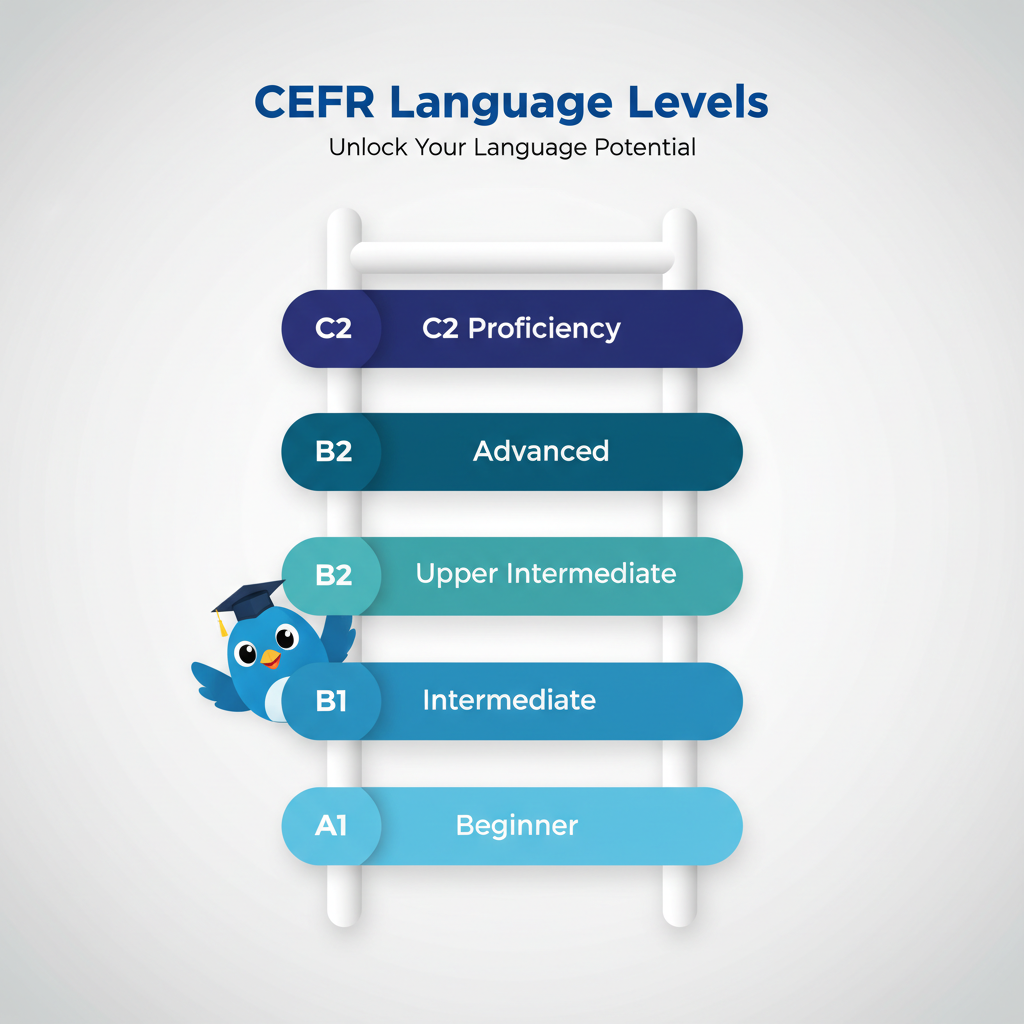
The framework is divided into three broad categories, each containing two sub-levels:
- A Levels (Basic User): A1 (Beginner) and A2 (Elementary).
- B Levels (Independent User): B1 (Intermediate) and B2 (Upper Intermediate).
- C Levels (Proficient User): C1 (Advanced) and C2 (Mastery).
The A Levels: Building the Foundation
At the A1 level, you are a "breakthrough" learner. You can understand very basic phrases and introduce yourself. You can ask and answer simple questions about personal details, such as where you live and people you know.
Moving to A2, you become a "waystage" learner. You can communicate in simple and routine tasks. You can describe your background, immediate environment, and matters in areas of immediate need in simple terms.
How to progress from A to B:
- Focus on high-frequency vocabulary: Don't worry about niche technical terms yet. Master the top 1,000 words.
- Master basic grammar: Focus on present, past, and future tenses.
- Start speaking early: Use tools like the AI tutor on Hamzaban to practice low-stakes conversations without the fear of judgment.
The B Levels: Gaining Independence
B1 is often called the "threshold" level. This is where the magic happens. You can deal with most situations likely to arise while traveling in an area where the language is spoken. You can produce simple connected text on topics that are familiar or of personal interest.
B2 is the "vantage" level. At this stage, you can understand the main ideas of complex text on both concrete and abstract topics. You can interact with a degree of fluency and spontaneity that makes regular interaction with native speakers quite possible without strain for either party. Many learners find themselves hitting a wall between B1 and B2 -- learn how to overcome the language learning plateau.
How to progress from B1 to B2:
- Consume native content: Start watching movies with target-language subtitles or listening to podcasts designed for intermediate learners.
- Expand your connectors: Learn how to use transition words (e.g., "furthermore," "nevertheless," "consequently") to make your speech more fluid.
- Targeted Gap Practice: Use Hamzaban to identify specific grammatical weaknesses and turn them into strengths through adaptive exercises.
The C Levels: Achieving Mastery
C1 is for advanced learners who can understand a wide range of demanding, longer texts and recognize implicit meaning. You can express ideas fluently and spontaneously without much obvious searching for expressions.
C2 is the highest level, often equated to near-native proficiency. You can understand with ease virtually everything heard or read. You can summarize information from different spoken and written sources, reconstructing arguments and accounts in a coherent presentation.
Why Your Level Matters
Knowing your CEFR level helps you avoid the two biggest traps in language learning: boredom and frustration. If you study material that is too easy (far below your level), you get bored. If it's too hard (far above your level), you get discouraged.
Effective learning happens in the "Zone of Proximal Development"—the sweet spot just above your current ability. By identifying your CEFR level, you can select content that provides just the right amount of challenge.
Actionable Tips to Level Up
1. Consistency Over Intensity
It is better to study for 20 minutes every day than for four hours once a week. Language learning is about muscle memory and neurological pathways. Daily exposure keeps the "language engine" warm.
2. Use Active Recall and Spaced Repetition
Don't just read word lists. Test yourself. Use flashcards or interactive exercises that force you to produce the language. Learn more about how spaced repetition accelerates vocabulary learning. This strengthens the retrieval paths in your brain.
3. Embrace Mistakes
At the A and B levels, your goal is communication, not perfection. Every mistake is a data point that helps your brain calibrate the correct rules of the language. If you are afraid to make mistakes, you will never reach B2 fluency.
4. Personalize Your Learning
Generic textbooks can only take you so far. To reach the higher B and C levels, you need to talk about things you actually care about. Whether it's technology, cooking, or history, tailor your vocabulary building to your interests.
How Hamzaban Helps You Progress
Traditional classrooms often move at the speed of the slowest student. Hamzaban changes that by using AI to adapt to your specific CEFR level.
The platform identifies the "gaps" in your knowledge. If you're a B1 learner who still struggles with irregular past tense verbs, Hamzaban's AI tutor will prioritize those in your exercises. This personalized approach ensures you spend your time where it matters most, accelerating your journey to the next level.
Try Hamzaban free today and see how personalized AI tutoring can transform your progress.
Conclusion
The journey from A1 to C2 is a marathon, not a sprint. By understanding the CEFR framework, you can set clear milestones and celebrate the small wins along the way. Whether you are just starting out or looking to polish your advanced skills, remember that the best way to progress is through consistent, targeted practice.
What level are you aiming for this year? Start practicing now and turn your language goals into reality.