
How to Build a Daily Language Learning Habit That Sticks
We have all been there. You start a new language with a burst of inspiration, buying textbooks and downloading every app available. But a few weeks later, the notifications go ignored, and the books gather dust on your shelf.
The missing ingredient isn't talent or intelligence; it is consistency. In the world of linguistics, small daily efforts outperform infrequent marathons every single time. To truly master a new tongue, you need a system that makes showing up inevitable.
In this guide, we will explore the science of habit formation and how you can apply it to your journey with Hamzaban. By the end, you will have a blueprint for a routine that feels less like a chore and more like a natural part of your day.
The Power of Atomic Habits in Language Learning
James Clear, the author of Atomic Habits, popularized the idea that massive success doesn't require massive action. Instead, it comes from the compound interest of 1% improvements. For language learners, this means focusing on the system rather than just the goal.
Instead of saying "I want to be fluent in six months," focus on "I will practice for ten minutes every morning." When the barrier to entry is low, your brain is less likely to resist the task.
Why Small Wins Matter
Every time you complete a quick exercise or learn five new words, you are casting a vote for the type of person you want to become. You are proving to yourself that you are a language learner.
Use Habit Stacking to Find Hidden Time
One of the biggest excuses for not learning a language is a lack of time. However, most of us have "dead time" throughout the day—moments where our bodies are busy but our minds are free.
Habit stacking is the process of anchoring a new habit to an existing one. The formula is simple: After [Current Habit], I will [New Habit].
- Morning Coffee: After I pour my first cup of coffee, I will review ten flashcards using spaced repetition techniques.
- Commuting: While I drive or take the train, I will listen to a language podcast.
- Lunch Break: After I finish eating, I will spend five minutes chatting with an AI tutor.
- Bedtime: After I brush my teeth, I will read one short article in my target language.
By attaching your practice to things you already do, you remove the need for willpower. The existing habit becomes the trigger for the new one.
Create an Environment for Success
Willpower is a finite resource. If you have to search for your textbook or remember your login every time you want to study, you are creating friction. To build a habit that sticks, you must design your environment to make the "good" habit the path of least resistance.
Digital Environment Design
Your phone is usually a distraction, but it can be your best tool. Move your language learning apps to your home screen dock. Disable notifications for social media and enable them for your study tools.
Physical Environment Design
If you prefer physical books, leave them open on your desk or nightstand. If you use sticky notes for vocabulary, place them on the items they describe—the fridge, the mirror, or the front door.
The Role of Adaptive Technology
Traditional methods often fail because they are too rigid. If a lesson is too easy, you get bored; if it’s too hard, you get frustrated. This is where personalized AI is revolutionizing language learning.
Platforms like Hamzaban use adaptive algorithms to identify your specific gaps. Instead of repeating things you already know, the system focuses on your weaknesses. This keeps you in the "Goldilocks Zone" of difficulty, which is essential for maintaining motivation over the long term.
By using the Hamzaban web app, you can engage in personalized exercises that feel like a game rather than a lecture. This dopamine hit makes it much easier to return to the app day after day.
Overcoming the "All or Nothing" Mentality
Life happens. You will get sick, your work will get busy, or you will simply have a bad day. The difference between those who succeed and those who quit is how they handle these disruptions.
The "Never Miss Twice" Rule
If you miss a day, don't beat yourself up. But don't let it happen two days in a row. Missing one day is an accident; missing two days is the start of a new habit of not practicing.
The Two-Minute Version
On your busiest days, do a "two-minute version" of your habit. Can't do a full hour of grammar? Just do one quick exercise. The goal isn't the progress made that day; it's maintaining the integrity of the habit.
Track Your Progress (Visually)
Humans are visual creatures. Seeing a streak of checked boxes provides a sense of accomplishment that fuels further action. Whether it is a physical calendar on your wall or a digital tracker, make sure you can see your consistency.
Celebrate the Milestones
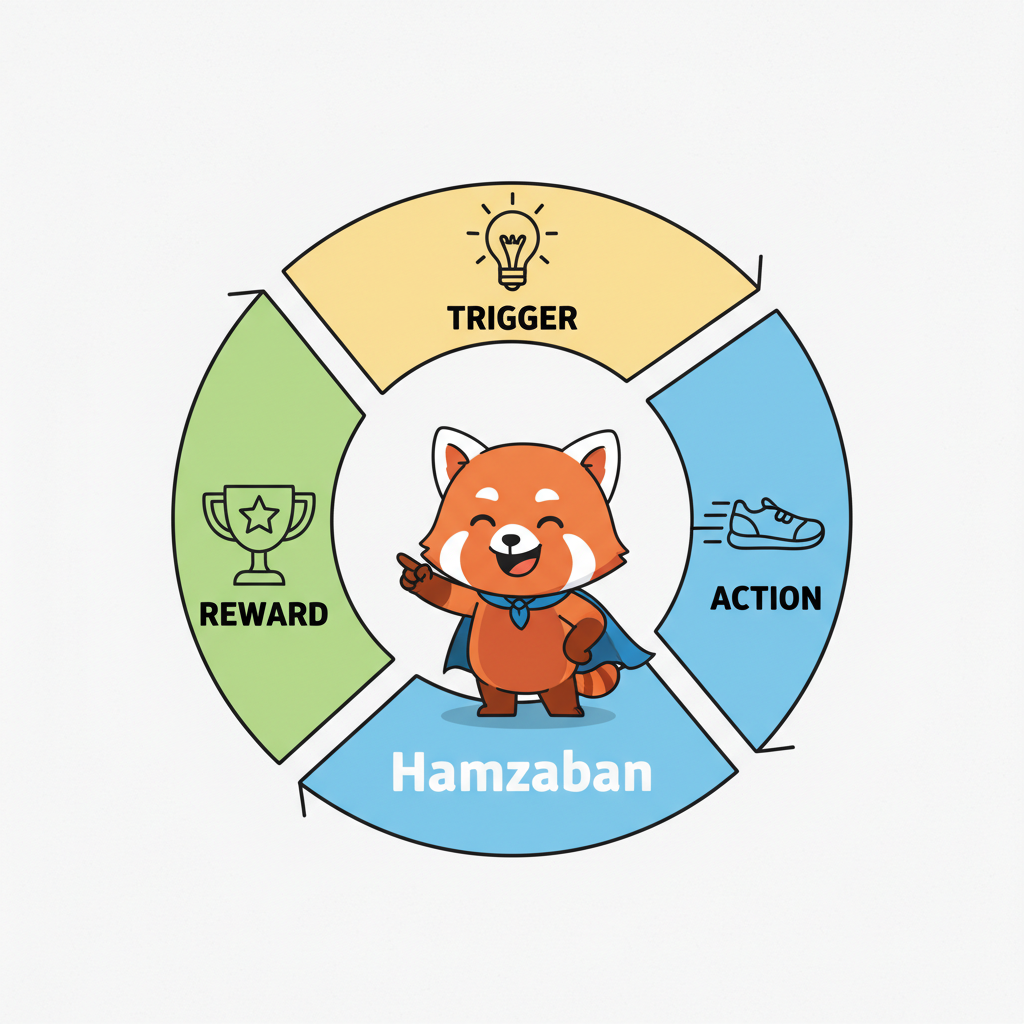
Don't wait until you are fluent to celebrate. Reward yourself when you hit a 7-day streak, or when you finish your first short story. These small rewards reinforce the habit loop (Trigger -> Action -> Reward).

Conclusion: Start Small, Start Today
You don't need a perfect plan to start. You just need a small action that you can repeat daily. Language learning is a marathon, not a sprint, and the most important step is the one you take today.
Ready to build your routine? Try Hamzaban free and see how personalized, AI-driven practice can transform your daily habits into lasting fluency.