

How Spaced Repetition Accelerates Vocabulary Learning
Have you ever spent hours cramming new words into your brain, only to find that forty-eight hours later, they have completely vanished? This frustrating phenomenon is not a sign of poor intelligence; it is simply how the human brain is wired.
To truly master a language, you need to move beyond traditional rote memorization. The secret to long-term retention lies in a psychological technique known as Spaced Repetition (SRS). By understanding the science of memory and utilizing modern tools, you can slash your study time while doubling your retention rate.
The Science of Forgetting: Why We Lose New Words
In the late 19th century, psychologist Hermann Ebbinghaus conducted groundbreaking research on memory. He discovered the "Forgetting Curve," which illustrates how information is lost over time when there is no attempt to retain it.
When you learn a new word, your memory of it is at 100%. However, within just twenty-four hours, that retention can drop to as low as 20% if you don't review it. The brain is efficient; it discards information it deems unnecessary to save energy.
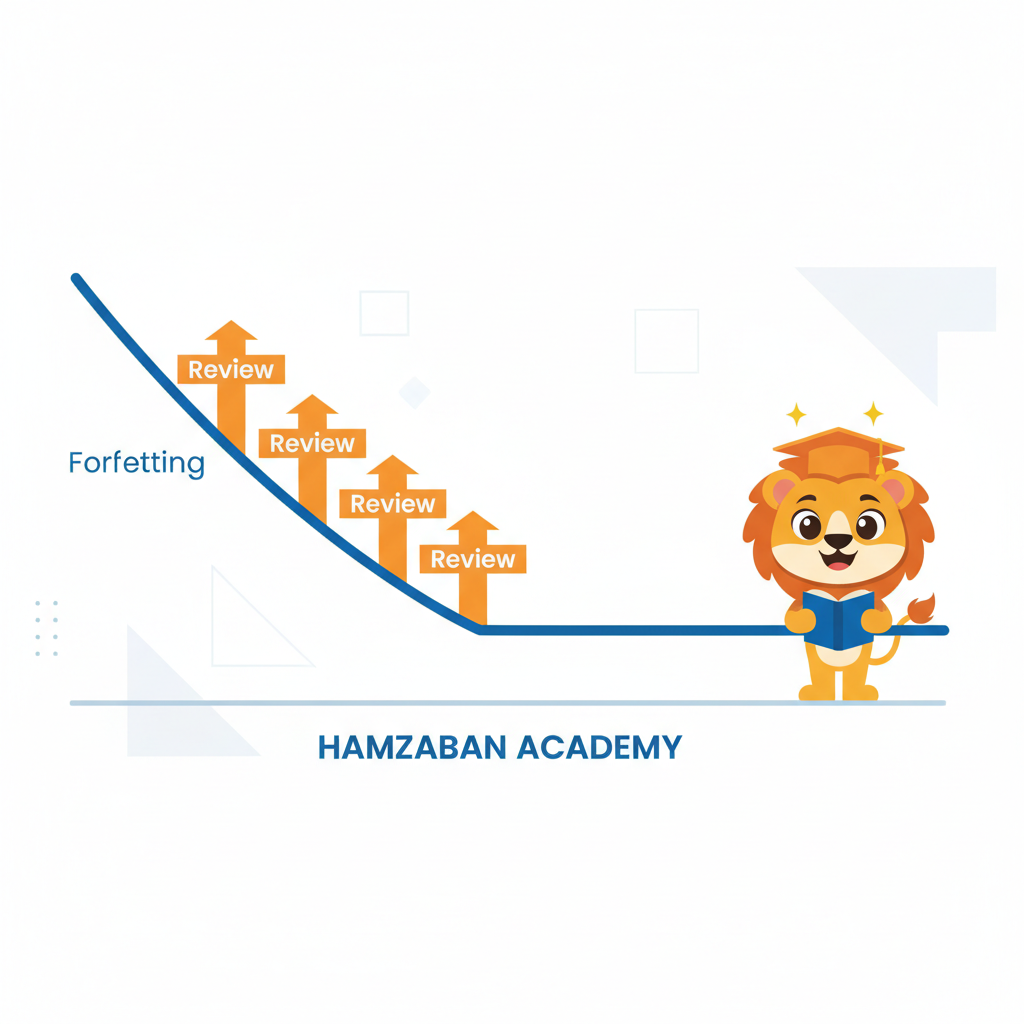
Breaking the Curve
The goal of Spaced Repetition is to "hack" this curve. Every time you review a word just before you are about to forget it, the Forgetting Curve flattens. The more times you review at the right intervals, the longer that word stays in your long-term memory.
What is a Spaced Repetition System (SRS)?
An SRS is a learning technique that incorporates increasing intervals of time between subsequent reviews of previously learned material. Instead of reviewing the same list of words every day, an SRS algorithm identifies which words you find difficult and which you find easy.
- Difficult words: These appear more frequently until they are mastered.
- Easy words: These are pushed further into the future, appearing weeks or even months later.
This efficiency ensures you are always working at the edge of your knowledge. Platforms like Hamzaban use these principles to ensure that the vocabulary you practice actually sticks, rather than fading away after a single session.
Why SRS is Superior to Cramming
Cramming—or "massed practice"—might help you pass a test tomorrow, but it is the least effective way to learn a language for life. Here is why Spaced Repetition wins every time:
- Cognitive Load Management: By spreading out your learning, you avoid the mental exhaustion that comes with long study sessions.
- The Spacing Effect: Research shows that our brains learn more effectively when we space out our study sessions rather than bundling them together.
- Active Recall: SRS forces you to pull information from your brain rather than just recognizing it on a page. This "heavy lifting" strengthens the neural pathways associated with that word.
How to Implement Spaced Repetition in Your Routine
You don't need to be a scientist to benefit from SRS. You can start optimizing your study habits today with these actionable steps:
1. Use Digital Flashcards
While paper flashcards are a classic, digital systems are far more efficient. They automate the scheduling for you. When you use the adaptive exercises on Hamzaban, the system tracks your progress and knows exactly when to resurface a word you struggled with previously.
2. Keep Your Cards Simple
A common mistake is putting too much information on one card. If a card has a long sentence, three definitions, and two synonyms, your brain will get overwhelmed. Stick to one clear concept per card: the word on one side and its meaning (or a picture) on the other.
3. Study in Short Bursts
Because SRS is so efficient, you only need 10 to 15 minutes a day to see massive results. Building a daily language habit is more important than duration. Reviewing your words during your morning coffee or while waiting for the bus is often more effective than a two-hour session on Sunday.

Enhancing SRS with Context
While SRS is incredible for memorization, words don't exist in a vacuum. To move from "knowing" a word to "using" it, you must see it in context.
- Read sentences, not just words: Try to learn vocabulary within a short phrase.
- Listen to native speakers: Hearing the word used in conversation reinforces the memory.
- Use an AI Tutor: Engaging in a conversation where you are forced to use your new vocabulary is the ultimate test of retention.
If you want to see how AI can create a personalized path for your vocabulary growth, you can try Hamzaban free. The platform combines the power of SRS with interactive AI tutoring to help you bridge the gap between memory and fluency.
Overcoming the "Intermediate Plateau"
Many learners hit a wall once they reach an intermediate level, often called the intermediate plateau. They know the basic 1,000 words, but the next 4,000 feel impossible to grasp. This is where Spaced Repetition shines.
At the intermediate level, you encounter "low-frequency" words—words that don't appear in every conversation but are essential for nuance. Because you don't hear them every day, you are more likely to forget them. An SRS provides the artificial exposure needed to keep these rare words fresh in your mind.
Tips for Long-Term Success
- Don't let your reviews pile up: If you skip a week, the number of cards to review can be daunting. Try to do at least a few every day.
- Be honest with yourself: If you almost remembered a word but not quite, mark it as "hard" or "wrong." The algorithm only works if you provide accurate feedback.
- Celebrate progress: Look back at the words you mastered six months ago. Seeing your "matured" vocabulary list is a powerful motivator.
Final Thoughts
Learning a language is a marathon, not a sprint. Spaced Repetition is the equipment that makes the run easier. By aligning your study habits with how your brain actually functions, you stop fighting against your memory and start working with it.
Ready to put the science of memory to work for you? Start practicing with Hamzaban today and experience a smarter way to master new languages.