

7 Common Mistakes English Speakers Make When Learning Farsi
Learning Farsi (Persian) is a rewarding journey that opens the door to a rich culture, exquisite poetry, and the hospitality of millions. However, for native English speakers, the transition isn't always seamless.
From the right-to-left script to a completely different sentence structure, Farsi presents unique challenges. While making mistakes is a natural part of the learning process, identifying them early can accelerate your path to fluency.
In this guide, we’ll explore the seven most common pitfalls English speakers encounter and how to avoid them using modern tools like Hamzaban.
1. Overlooking the SOV Sentence Structure
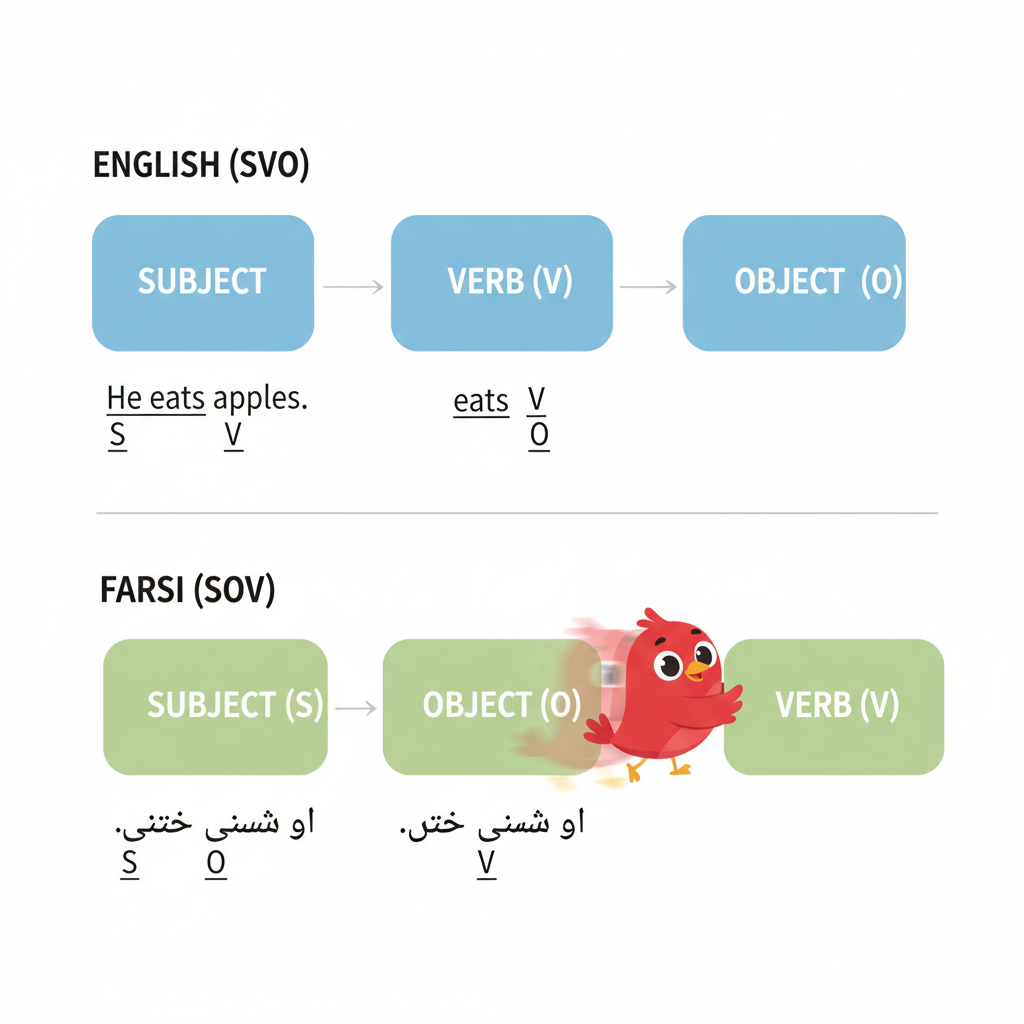
In English, we follow a Subject-Verb-Object (SVO) pattern: "I eat the apple." In Farsi, the verb almost always comes at the end. This is known as Subject-Object-Verb (SOV).
Many beginners try to translate word-for-word, resulting in sentences that sound fragmented to native ears. Instead of saying "I eat apple," you must think as "I apple eat" (Man sib mikhoram).
How to fix it:
- Practice moving the action to the end of your thoughts.
- Use the Hamzaban AI tutor to get instant corrections on your sentence construction.
2. Mixing Up Formal and Informal Registers
Farsi has a significant gap between the written language (Ketabi) and the spoken language (Mohaverei). Many textbooks focus on the formal style, which can make you sound like a 19th-century poet in a modern teahouse.
For example, the word for "is" in formal Farsi is ast, but in spoken Farsi, it often shortens to a simple suffix -e. If you use formal grammar in a casual conversation, you might come across as overly stiff.
Pro Tip:
Listen to contemporary Iranian media or use interactive exercises on Hamzaban to hear how native speakers actually talk in daily life.
3. Neglecting the Importance of "Ezafe"
The Ezafe is a short vowel sound (usually '-e' or '-ye') that connects words. It is the "glue" of the Persian language, used to link nouns to adjectives or to show possession.
English speakers often forget to pronounce this link because it isn't written in the standard Persian script. Without the Ezafe, a phrase like "my book" (ketab-e man) just becomes two unrelated words: "book I."
How to master the Ezafe:
- Think of it as a bridge that must be crossed before moving to the next word.
- Read aloud frequently to build the muscle memory for this connecting sound.
4. Misusing Personal Pronouns and Verb Conjugations
Farsi is a "pro-drop" language, meaning the subject pronoun (I, you, he/she) is often omitted because the verb ending tells you who is performing the action.
English speakers tend to over-rely on pronouns like Man (I) or To (You). While not grammatically wrong, repeating them constantly sounds repetitive. The verb ending -am already tells the listener you are talking about yourself.
5. Confusing the "Rā" (را) Marker
The word Rā is unique to Farsi and has no direct equivalent in English. It is used to mark a specific direct object.
Beginners often forget to include it or, conversely, use it where it doesn't belong. You use Rā when you are talking about a specific thing (e.g., "I saw the book") but not for general things (e.g., "I saw a book").
Rule of Thumb:
If you can put the word "the" before the object in English, you probably need Rā in Farsi.
6. Pronunciation Pitfalls: The 'Q' and 'G' Sounds
Farsi has a few sounds that don't exist in English, specifically the Persian Qaf (ق) and Gheyn (غ). To English ears, these often sound like a 'G' or a 'K', but they are actually produced deeper in the throat.
Mispronouncing these can sometimes change the meaning of a word entirely. While Iranians are generally very forgiving of accents, using AI-powered pronunciation feedback to master these sounds will significantly boost your confidence.
7. Translating Idioms Literally
Farsi is a language of deep politeness (Ta’arof) and vivid metaphors. If you translate English idioms literally into Farsi, or vice versa, you will likely confuse your listener.
For example, if you want to say someone is very dear to you, a Persian might say "Your place is empty" (Jāyat khāli-st). If you try to use English-style idioms, the cultural nuance is lost.
Practical Advice:
Learn phrases as whole units rather than individual words. You can try Hamzaban free to explore a library of common phrases and cultural expressions that go beyond literal translation.
Conclusion: Practice Makes Persian
Avoiding these mistakes isn't about being perfect; it's about being understood and connecting more deeply with the Persian-speaking world. The key is consistent, targeted practice that focuses on your specific weak points.
Whether you are struggling with the Ezafe or trying to master the SOV word order, tools like Hamzaban provide the adaptive tutoring you need to turn these common mistakes into your greatest strengths.
Start your journey today and speak Farsi with the confidence of a native!